

Automatic Monitoring
Access: Admins only
Navigation: Settings > Automatic Monitoring
Sifflet's Automatic Monitoring lets admins monitor entire schemas or databases using default monitors. Because it relies on metadata and system-level configurations, this feature keeps monitoring fast and low-cost.
Overview
When you enable it, Sifflet automatically monitors all tables within the selected schemas or databases. This includes tables added in the future—Sifflet detects and begins monitoring them without additional configuration.
Available Automatic Monitors
Sifflet can apply the following monitors automatically:
-
Freshness (Metadata):
Dynamically alerts if the time since the last update exceeds expected thresholds.
Runs every hour. -
Volume (Full Table Scan):
Dynamically alerts if the total number of rows in the table significantly diverges from historical norms.
Runs daily at midnight UTC. -
Schema Change:
Alerts when a table’s schema changes—for example, when a column is added or removed.
Runs daily at midnight UTC.
These monitors query only metadata and are designed to be lightweight, incurring minimal cost on your warehouse.
Monitor Creation Scope
- Applies only to tables.
- Support for views and other dataset types is planned.
- Limited to 8,000 monitored datasets.
Enabling Automatic Monitoring
- Go to Settings > Automatic Monitoring.
- Select the schemas or databases to monitor automatically.
- Sifflet begins creating monitors for all detected tables in those schemas.
Only admins can enable or manage Automatic Monitoring.
Viewing and Filtering Monitors
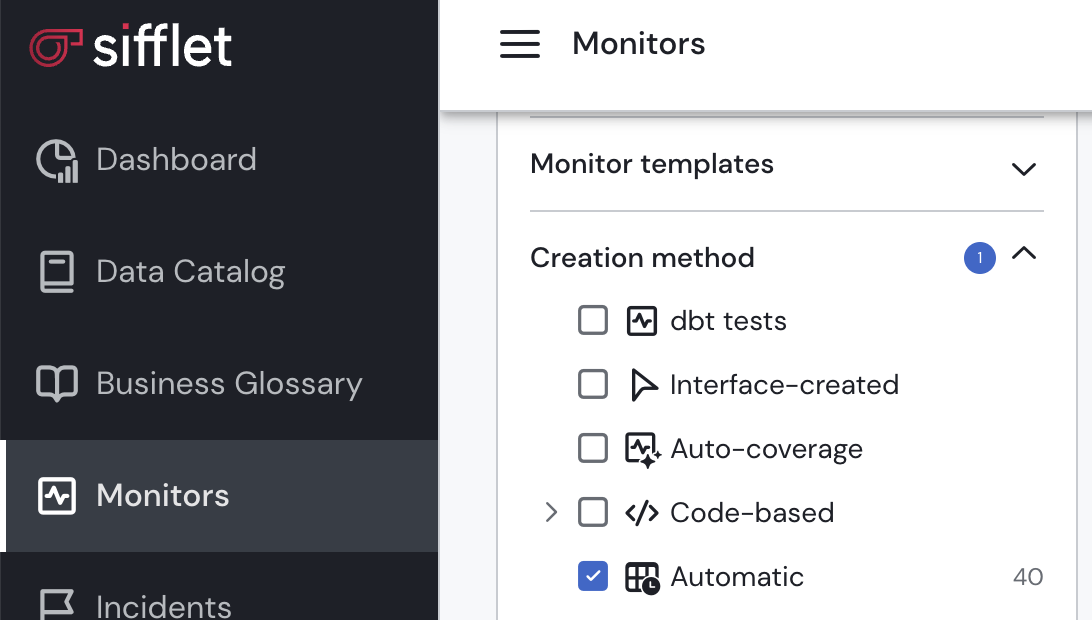
You can see all automatically created monitors on the Monitors page. You can filter them by Creation Method using the sidebar:
Automaticdbt testsInterface-createdAuto-coverageCode-based
Notes
- Monitor availability depends on your data platform. To check whether a monitor is available for your data platform, see the documentation of the corresponding monitor template and the collected data page of your integration, listed in Integrations.
Updated 7 days ago